...

Knee Arthroscopy

Knee Arthroscopy Near You in New Jersey

Knee pain can interfere with nearly every part of your daily life. Walking, climbing stairs, exercising, working, or even standing for long periods may be difficult when your knee is injured or damaged. While some knee conditions improve with conservative treatment, others require surgical intervention.
At Interventional Spine & Surgery Group, patients receive comprehensive orthopedic treatment for knee injuries and chronic joint problems. Using advanced diagnostics, minimally invasive techniques, and personalized treatments and rehabilitation, we help patients recover safely so they can return to normal activities quickly. Our medical team prioritizes seeing you right away and beginning treatment as soon as possible, so you don’t have to continue living in pain. Learn more about knee arthroscopy near you in New Jersey.

Key Takeaways

  • Knee arthroscopy is a minimally invasive procedure that diagnoses and treats a wide range of knee conditions, including meniscus tears, ligament injuries, cartilage damage, and knee arthritis.
  • Small incisions mean less tissue damage, reduced pain, and a faster recovery compared to open surgery.
  • Most patients return to light activity within a few weeks and full activity within a few months.
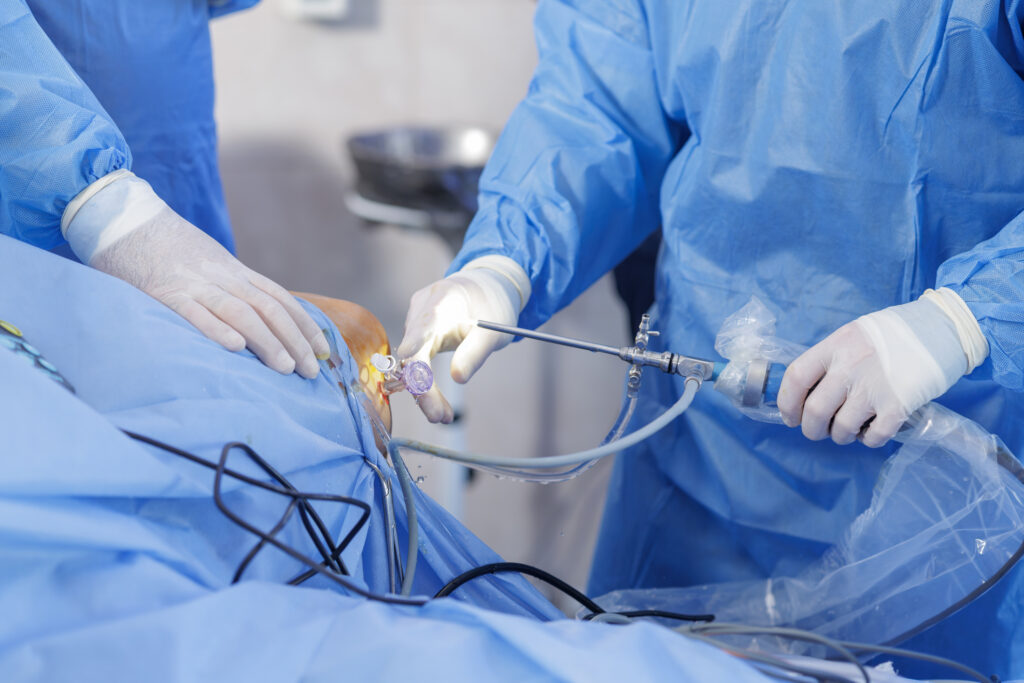
Orthopedic surgeons performing knee arthroscopy in operating room

Why Choose Knee Arthroscopy?

Knee arthroscopy allows orthopedic surgeons to evaluate and treat problems inside the knee joint without large surgical incisions. During the procedure, a small camera, called an arthroscope, is inserted into the knee through tiny incisions. The camera displays detailed images on a monitor, allowing the surgeon to examine cartilage, ligaments, tendons, bone surfaces, and other structures within the joint.
Specialized instruments can then be used to repair or remove damaged tissue with precision. Because arthroscopy is minimally invasive, it offers several advantages compared to traditional open surgery.

What Are the Benefits of Knee Arthroscopy?

Many patients choose knee arthroscopy because it can reduce pain and recovery time while effectively treating knee problems. Other benefits include:
  • Small incisions with minimal scarring
  • Less damage to the surrounding muscles and tissue
  • Lower risk of infection
  • Shorter hospital stays
For many patients, arthroscopy can improve knee mobility, joint stability, pain levels, and overall quality of life.

What Conditions Can Knee Arthroscopy Treat?

Arthroscopy can be used to treat a wide range of orthopedic conditions affecting the knee joint. At Interventional Spine & Surgery Group, we use arthroscopy to diagnose and treat:
  • Meniscus tears
  • Cartilage injuries
  • Loose bone or cartilage fragments
  • Anterior cruciate ligament (ACL) tears
  • Synovitis, or inflammation
  • Knee instability
  • Patellar tracking problems
  • Fractures
  • Early joint degeneration
We may use this procedure to evaluate causes of persistent knee pain when nonsurgical treatment hasn’t resolved your symptoms. In some cases, we may also combine arthroscopy with other procedures to restore stability and improve your long-term knee function.

What Should I Expect Before Knee Arthroscopy?

Before your procedure, our team will walk you through everything you need to know. The more prepared you are, the smoother your surgery (and recovery) will be. Our pre-operative process looks like:
  • Consultation: Your doctor reviews your history, imaging, and symptoms to confirm arthroscopy is the right approach.
  • Testing: You may need blood work, an electrocardiogram (EKG), or updated imaging.
  • Medication review: You’ll need to pause certain medications, including blood thinners and anti-inflammatories.
  • Fasting: You’ll be asked to stop eating and drinking several hours before your procedure.
  • Arrange a ride: Because you’ll get anesthesia, you’ll need someone to drive you home.
  • Set up recovery at home: Prepare a comfortable space with ice, pillows for elevation, and easy access to essentials.
Following these steps carefully helps reduce your risk and sets you up for the best possible recovery.

How Is Knee Arthroscopy Performed?

Knee arthroscopy is typically performed on an outpatient basis and takes about an hour:
  • Anesthesia: You’ll receive local or general anesthesia, so you’re comfortable throughout the surgery.
  • Incisions: Your surgeon makes two or three small incisions around the knee, each roughly the size of a buttonhole.
  • Camera insertion: The surgeon inserts a sterile saline solution that fills the joint to expand the space and improve visibility. Then, the surgeon inserts the arthroscope.
  • Diagnosis and repair: Your surgeon examines the joint on a monitor and performs any necessary repairs, such as trimming, repairing, or removing damaged tissue, through additional incisions.
  • Closure: Once complete, the surgeon removes the instruments, drains the fluid, and closes the incisions with small sutures or bandages.
The minimally invasive nature of the procedure means less trauma to the surrounding tissue and a more straightforward recovery.

What Should I Expect During Recovery After Knee Arthroscopy?

Most patients go home on the same day. What your recovery looks like depends on which repairs are made. However, there is a general timeline you can expect:
  • Days 1-3: Focus on rest, ice, compression, and elevation. You’ll experience some normal pain and swelling, but these should be manageable with prescribed medication.
  • Weeks 1-2: You’ll begin gentle range-of-motion exercises. You may also need crutches to help reduce some of the weight on your knee.
  • Weeks 2-6: You’ll start physical therapy and focus on strength, stability, and mobility.
  • Months 2-4: Most patients return to light work and daily activities. As your strength improves, you can start to add more demanding activities and regular exercise.
  • Months 4-6+: Your surgeon will perform a recovery assessment to determine whether you’re ready to return to sports and high-impact activity.
As with most surgeries, physical therapy is a critical part of your recovery to help you regain your knee’s strength and mobility. When you commit to your rehab, you’ll see better results.

What Follow-Up Care Is Needed After Knee Arthroscopy?

With Interventional Spine & Surgery Group, your recovery doesn’t end when you leave the operating room. We schedule follow-up appointments to monitor your healing and make sure you’re progressing well. During these visits, our team will:
  • Check your incision sites
  • Review your range of motion and strength
  • Adjust your physical therapy as needed
  • Address any concerns or complications
Your doctor will also discuss long-term strategies to protect your knee from future injury. These may include activity modifications, strengthening exercises, and lifestyle changes that reduce wear on the joint.

Why Choose Interventional Spine & Surgery Group?

At Interventional Spine & Surgery Group, you’re not just seeing one doctor. You have access to a multidisciplinary team, including pain management specialists, physiatrists, physical therapists, chiropractors, and neurologists, all under one roof. With us, you’ll have seamless coordination from your diagnosis through your recovery to support you at every stage. We can see you now, we care, and we’ll help you get better right away.

Find Expert Knee Arthroscopy Near You in New Jersey

Knee pain can limit your life. However, with the right care, you can get back to the activities you enjoy. Knee arthroscopy offers a proven, minimally invasive path to relief. Team at Interventional Spine & Surgery Group are here to guide you through it, with fast access and patient- centered care. Contact us today to schedule a consultation at one of our many convenient locations near you in New Jersey.

Frequently Asked Questions About Knee Arthroscopy

What is knee arthroscopy?
Knee arthroscopy is a minimally invasive surgical procedure that uses a small camera and specialized instruments to diagnose and treat problems inside the knee joint.
Arthroscopy uses much smaller incisions than traditional open surgery. This approach results in less tissue disruption, reduced pain, and faster recovery.
Knee arthroscopy can treat meniscus tears, cartilage injuries, ligament problems, inflammation, loose fragments, and other joint conditions.
Recovery varies depending on the procedure performed. Some patients recover within several weeks. However, more complex repairs may take several months of rehabilitation.
Many patients begin walking shortly after surgery. You may need crutches or a brace temporarily for extra support.

As with any surgery, there are risks. These include:

  • Infection
  • Bleeding
  • Stiffness
  • Blood clots
  • Swelling
  • Delayed healing

Your surgeon will review your individual risk factors before surgery so that you can make an informed decision.

Yes. Arthroscopy may help relieve certain symptoms related to arthritis. However, treatment recommendations depend on how severely your joint has degenerated.
Knee arthroscopy for meniscus repair is often highly effective. Outcomes depend on the location and severity of the tear, as well as the patient’s age and activity level. Most patients experience significant pain relief and improved function, as long as they keep up with their rehab.
What is knee arthroscopy?

Knee arthroscopy is a minimally invasive surgical procedure that uses a small camera and specialized instruments to diagnose and treat problems inside the knee joint.

How is knee arthroscopy different from traditional surgery?

Arthroscopy uses much smaller incisions than traditional open surgery. This approach results in less tissue disruption, reduced pain, and faster recovery.

What conditions are treated with knee arthroscopy?

Knee arthroscopy can treat meniscus tears, cartilage injuries, ligament problems, inflammation, loose fragments, and other joint conditions.

How long is the recovery for knee arthroscopy?

Recovery varies depending on the procedure performed. Some patients recover within several weeks. However, more complex repairs may take several months of rehabilitation.

How soon can I walk after a knee arthroscopy?

Many patients begin walking shortly after surgery. You may need crutches or a brace temporarily for extra support.

Are there any risks with knee arthroscopy?

As with any surgery, there are risks. These include:

  • Infection
  • Bleeding
  • Stiffness
  • Blood clots
  • Swelling
  • Delayed healing

Your surgeon will review your individual risk factors before surgery so that you can make an informed decision.

Can knee arthroscopy help with arthritis?

Yes. Arthroscopy may help relieve certain symptoms related to arthritis. However, treatment recommendations depend on how severely your joint has degenerated.

How effective is knee arthroscopy for repairing the meniscus?

Knee arthroscopy for meniscus repair is often highly effective. Outcomes depend on the location and severity of the tear, as well as the patient’s age and activity level. Most patients experience significant pain relief and improved function, as long as they keep up with their rehab.

Scroll to Top
Seraphinite AcceleratorOptimized by Seraphinite Accelerator
Turns on site high speed to be attractive for people and search engines.