 Skip to content
Non-Surgical Pain Relief
Non-Surgical Pain Relief Near You in New Jersey
Pain doesn’t always require surgery. Many patients with spine, joint, or nerve-related pain are candidates for non-surgical treatments that can reduce symptoms, improve function, and help identify the source of the problem, all without a single incision.
At Interventional Spine & Surgery Group, our care team offers a range of diagnostic-guided, non-surgical procedures for patients dealing with neck, back, arm, leg, hip, knee, shoulder, and nerve pain across New Jersey. These treatments may help identify the source of your pain, reduce inflammation, interrupt pain signals, or support a personalized plan that gets you moving again.
Every recommendation starts with a thorough clinical evaluation. Your provider will review your symptoms, imaging, prior treatment history, and response to any diagnostic injections before determining the best path forward. Learn how our non-surgical pain relief near you in New Jersey can help you feel better, and how we prioritize diagnosing your pain and beginning treatment right away.
Key Takeaways
- Non-surgical pain relief may help patients manage spine, nerve, and joint pain before surgery is considered.
- Image guidance, such as fluoroscopy or X-ray, may be used to help position needles accurately for injection-based procedures.
- A specialist can help determine whether injections, nerve blocks, rhizotomy, or another option is appropriate.
- Interventional Spine & Surgery Group has many convenient locations near you in New Jersey, providing fast access to patient-centered care.
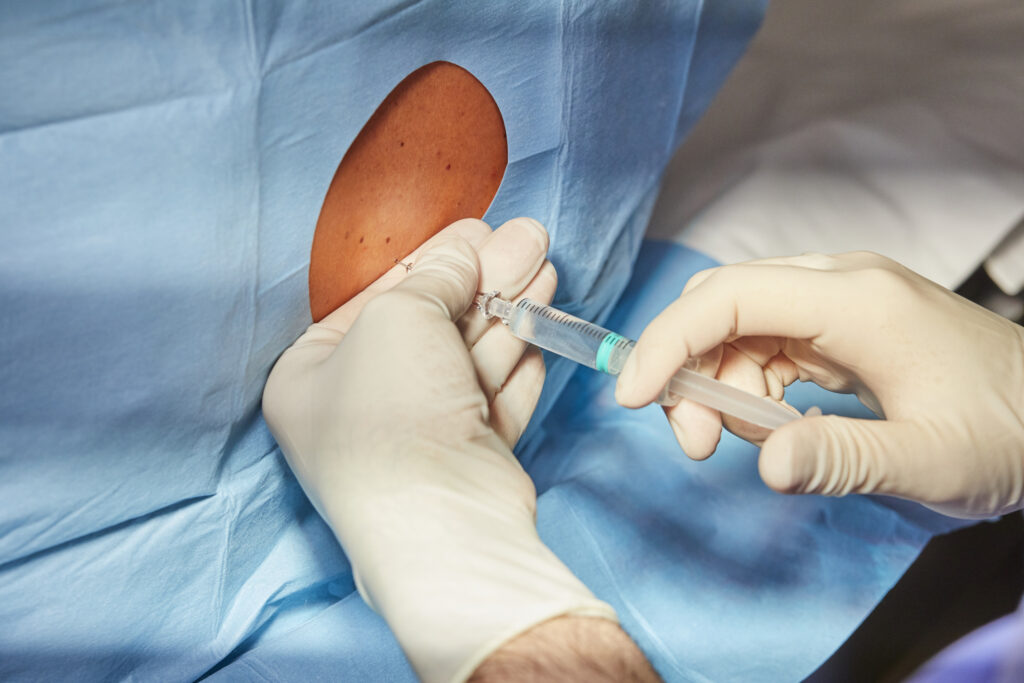
Types of Treatment: Are You a Candidate for Non-Surgical Pain Relief?
- Chronic neck, back, arm, or leg pain that limits your daily activities
- Nerve pain, tingling, numbness, or weakness
- Joint pain caused by arthritis, injury, or degeneration
- Pain that hasn’t improved with conservative care
- Diagnostic uncertainty, meaning you and your provider don’t yet have a clear answer about where the pain is coming from
Epidural Steroid Injections
An epidural steroid injection (ESI) delivers anti-inflammatory medication directly into the epidural space,
which is the area surrounding the spinal cord and nerve roots. The goal is to reduce swelling and
irritation around the affected nerve. This can provide pain relief and improve your ability to participate
in physical therapy and daily activities. ESIs may help address pain caused by:
- Herniated or bulging discs
- Spinal stenosis
- Nerve root irritation or compression
- Sciatica and radiating arm or leg pain
Electromyogram (EMG)
- Muscle function and electrical activity
- Motor neuron health and signal transmission
- Nerve conduction and how well signals travel through peripheral nerves
Major Joint Injections
Major joint injections deliver medication, such as a corticosteroid combined with a local anesthetic,
directly into a painful joint. These injections serve both diagnostic and therapeutic purposes. They can
reduce inflammation and provide pain relief while also helping confirm whether the joint itself is the
primary source of your pain. Commonly treated joints include:
- Hip
- Knee
- Shoulder
- Ankle
Medial Branch Facet Blocks and Selective Nerve Root Blocks
Facet joints connect the vertebrae throughout your spine, from your cervical spine in your neck down to the lumbar spine in your lower back. They’re a common source of axial neck and back pain, especially after an injury or with age-related degeneration. Each facet joint is supplied by medial branch nerves, which transmit pain signals from the joint to the brain.
A medial branch facet block delivers a small amount of local anesthetic near those nerves to temporarily interrupt the pain signal. This injection is primarily diagnostic. If your pain signal improves significantly after the block, it confirms the facet joint as the likely cause of your pain. That information helps your doctor determine whether you’re a candidate for a rhizotomy.
A selective nerve root block (SNRB) targets a specific spinal nerve root rather than the facet joint itself. This procedure is used when a nerve is compressed or irritated, often from a herniated disc or bony narrowing that causes radiating pain into the arm or leg. Like facet blocks, nerve root blocks can serve both a diagnostic and therapeutic role. They can help reduce inflammation around the nerve while also confirming which nerve is responsible for your symptoms.
Rhizotomy
- A positive diagnostic block has confirmed facet joint pain
- Pain is localized to one or a few spinal levels
- You don’t have additional symptoms or major neurological defects
Sacroiliac Joint Injections
An SI joint injection delivers anti-inflammatory medication directly into the joint. Like other diagnostic-
guided injections, it serves two purposes:
- Confirm whether the SI joint is the source of your pain
- Provide therapeutic relief from pain
How Do These Non-Surgical Treatments Fit into a Personalized Pain Relief Plan?
- Performing an evaluation: Your provider reviews your current symptoms, prior diagnoses, imaging studies, and what treatments you’ve already tried.
- Identifying the pain generator: Diagnostic injections, like facet blocks or nerve root blocks, help confirm which structure is responsible for your symptoms.
- Matching the procedure to the problem: Once we identify the source of your pain, your provider recommends the most appropriate treatment and intervention for your specific diagnosis.
- Monitoring your response: How your body responds after treatment informs the next step, whether that’s continued conservative care, rehabilitation, a follow-up injection, or a surgical consultation.
Why Choose Interventional Spine & Surgery Group?
- A specialized focus on spine, joint, and nerve-related pain
- Surgical and non-surgical perspectives that inform every evaluation and treatment recommendation
- Diagnostic-guided treatment planning, where evidence guides procedures
- Prioritization of fast access to care
- Multiple locations throughout New Jersey that make it easier to get seen quickly and close to where you live or work
- A patient-centered approach that focuses on restoring your function and mobility, so you can enjoy the activities that matter to you
Schedule an Evaluation for Neck, Back, Nerve, or Joint Pain Near You in New Jersey
Frequently Asked Questions About Non-Surgical Orthopedic and Spine Treatments
How do I know if I’m a candidate for non-surgical pain relief?
A clinical evaluation is the best way to find out. Your doctor will review your symptoms, imaging, and
treatment history to determine whether you’d benefit from an interventional procedure. In general,
patients with chronic pain, nerve-related symptoms, or joint pain that hasn’t responded to conservative
care are often good candidates.
What’s the difference between a diagnostic injection and a therapeutic injection?
A diagnostic injection identifies where pain is coming from by temporarily blocking a specific nerve or
joint. A therapeutic injection delivers anti-inflammatory medication to reduce pain and swelling.
How long do results from these injections last?
It depends on the procedure and the individual. Diagnostic injections like facet blocks are shorter-acting
because they’re used to confirm a pain source, not provide long-term relief. Therapeutic injections like epidural steroids or joint injections may provide relief for weeks to months, while rhizotomy can last
several months to over a year.
Will I need more than one injection?
Possibly. Some conditions benefit from a series of injections, and your doctor will monitor your response
after each treatment. Diagnostic injections are often followed by a therapeutic or ablative procedure if
results confirm your pain source.
Do these procedures require general anesthesia?
No, most don’t. Most of the non-surgical procedures we do at Interventional Spine & Surgery Group are
done with local anesthesia or light sedation. You’ll typically go home the same day.
Is an EMG painful?
Can I continue physical therapy while receiving these treatments?
In many cases, yes, and it’s often encouraged. Non-surgical procedures, such as epidural steroid
injections, are frequently used to reduce pain enough for patients to engage more effectively in physical
therapy and rehab. Your doctor will advise whether you can continue rehab based on your specific
situation.
What happens if non-surgical treatments don’t work?
If non-surgical care doesn’t provide enough relief, your doctor can discuss whether you’d benefit from
surgical options. At Interventional Spine & Surgery Group, we offer both non-surgical and surgical
treatments, meaning you won’t need a referral.
A clinical evaluation is the best way to find out. Your doctor will review your symptoms, imaging, and treatment history to determine whether you’d benefit from an interventional procedure. In general, patients with chronic pain, nerve-related symptoms, or joint pain that hasn’t responded to conservative care are often good candidates.
A diagnostic injection identifies where pain is coming from by temporarily blocking a specific nerve or joint. A therapeutic injection delivers anti-inflammatory medication to reduce pain and swelling.
It depends on the procedure and the individual. Diagnostic injections like facet blocks are shorter-acting because they’re used to confirm a pain source, not provide long-term relief. Therapeutic injections like epidural steroids or joint injections may provide relief for weeks to months, while rhizotomy can last several months to over a year.
Possibly. Some conditions benefit from a series of injections, and your doctor will monitor your response after each treatment. Diagnostic injections are often followed by a therapeutic or ablative procedure if results confirm your pain source.
No, most don’t. Most of the non-surgical procedures we do at Interventional Spine & Surgery Group are done with local anesthesia or light sedation. You’ll typically go home the same day.
In many cases, yes, and it’s often encouraged. Non-surgical procedures, such as epidural steroid injections, are frequently used to reduce pain enough for patients to engage more effectively in physical therapy and rehab. Your doctor will advise whether you can continue rehab based on your specific situation.
If non-surgical care doesn’t provide enough relief, your doctor can discuss whether you’d benefit from surgical options. At Interventional Spine & Surgery Group, we offer both non-surgical and surgical treatments, meaning you won’t need a referral.
