 Skip to content
Hemilaminectomy
What is a hemilaminectomy?
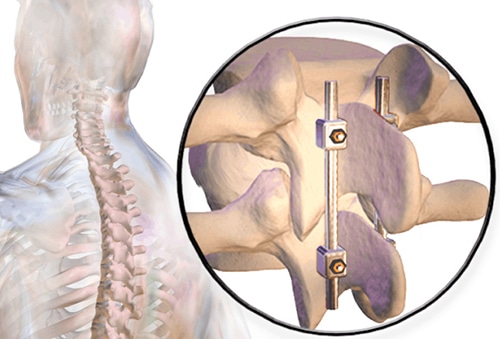
A hemilaminectomy, sometimes referred to as a laminotomy, is a minimally invasive surgical procedure that aims to enlarge the space in the spinal canal to reduce nerve compression or pressure. This is done by removing part of a vertebra, called a lamina, that has been damaged or is damaging surrounding structures. Each vertebra contains two laminae, which are bony segments that form the rear of the vertebral arch and serve as a base for the vertebrae, covering and protecting the spinal column. A hemilaminectomy can be done to address nerve compression in all three regions of the spine—lumbar, thoracic, and cervical.
What is the difference between a hemilaminectomy and a laminectomy?
How is a hemilaminectomy performed?
How is a hemilaminectomy performed?
Is hemilaminectomy a major surgery?
How long does it take to recover from a hemilaminectomy?
According to studies, hemilaminectomy has an advantage over other forms of spine surgery in that it minimizes injury to muscles, ligaments, and bones in and around the spine. This often helps recovery.
The spine surgeons at Interventional Spine & Surgery Group utilize minimally invasive techniques during surgery to make recovery as quick and with as little pain as possible.
A hemilaminectomy may be done in conjunction with another procedure in order to address a spine condition that is causing additional symptoms. For example, if you have severe disc damage, your surgeon may recommend hemilaminectomy discectomy surgery. Your surgeon will first remove part of the lamina (the hemilaminectomy) and then access and remove the damaged disc. This is the discectomy part of the procedure.
How long your hospital stay might be is dependent on how extensive your surgery was and what combination of procedures was involved.
When to consider a hemilaminectomy:
You may be a candidate for a hemilaminectomy if you suffer from a condition involving a pinched nerve. These spinal conditions may include:
- Degenerative disc disease
- Herniated disc
- Spinal stenosis
- Arthritis of the spine
If the source of your pain is nerve compression, you may experience symptoms such as:
- Numbness or decreased sensation
- Sharp, aching, or burning pain
- Tingling
- Muscle weakness
If you are suffering from neck or back pain associated with a pinched nerve and have exhausted conservative treatment options like physical therapy, injections, or massage, your doctor may suggest a hemilaminectomy.
Non-surgical treatment can address some of the pain and associated symptoms, but for a more serious case, the answer may be to surgically remove the bone and other material that is putting pressure on the nerves and causing your pain.
Not all patients with nerve compression are candidates for hemilaminectomy; patients with extensive compression may be better suited for a full laminectomy or another spine procedure, like a spinal fusion.
The surgical team at Interventional Spine & Surgery Group is equipped to perform a hemilaminectomy, along with various spine procedures, using minimally invasive techniques in order to optimize your recovery. Minimally invasive surgical techniques result in quicker recovery periods, smaller incisions and less scarring, lower risk of infection and complications, and less disruption of muscles, nerves, and other soft tissue.
Call us today to discuss whether a hemilaminectomy may be a good option to relieve your back pain.
