 Skip to content
Orthopedic and Spine Diagnostic Services
Orthopedic and Spine Diagnostic Services Near You in New Jersey
If you’re living with pain, your care team needs to understand what’s causing it before they can recommend a treatment plan. For patients with spine, orthopedic, nerve, or pain-related symptoms, diagnostic testing is how that happens and can help with targeted care.
At Interventional Spine & Surgery Group, our providers evaluate a wide range of conditions, from chronic neck and back pain to radiating arm and leg symptoms, nerve-related complaints, and complex orthopedic problems. We provide fast access to patient-centered care near you in New Jersey.
Diagnostic services offered at our practice include: electromyogram (EMG) and cervical and lumbar discograms. These tests are tools for gathering information. They work alongside a clinical evaluation, including your medical history, physical exam, and imaging, to help your doctor build a treatment plan that’s specific to your condition, anatomy, symptoms, and goals.
Key Takeaways
- Diagnostic testing helps identify the source of spine, nerve, and orthopedic pain before you begin treatment.
- EMG testing helps evaluate muscle and motor nerve function when symptoms include numbness, tingling, weakness, pain, or cramping.
- Cervical discograms help assess whether a disc in the neck may be contributing to neck, shoulder, arm, or nerve-related pain.
- Lumbar discograms help assess whether a disc in the lower back may be contributing to low back, hip, buttock, or leg pain.
- Interventional Spine & Surgery Group offers diagnostic and treatment services at multiple New Jersey locations.
- With diagnostic services available on-site, Interventional Spine & Surgery Group can evaluate conditions and begin treatment right away.
When Might Your Doctor Recommend Orthopedic and Spine Diagnostic Testing?
- Neck or back pain that hasn’t responded to conservative care
- Radiating pain into the arm or leg
- Numbness, tingling, or loss of sensation
- Muscle weakness or unexplained muscle pain and cramping
- Symptoms that suggest nerve irritation, disc injury, or another spine-related cause
How Do Diagnostics Support Treatment Planning?
- Non-surgical care, such as physical therapy or pain management
- Interventional procedures, such as epidural steroid injections or nerve root blocks
- Surgical consultation if a structural problem needs to be corrected
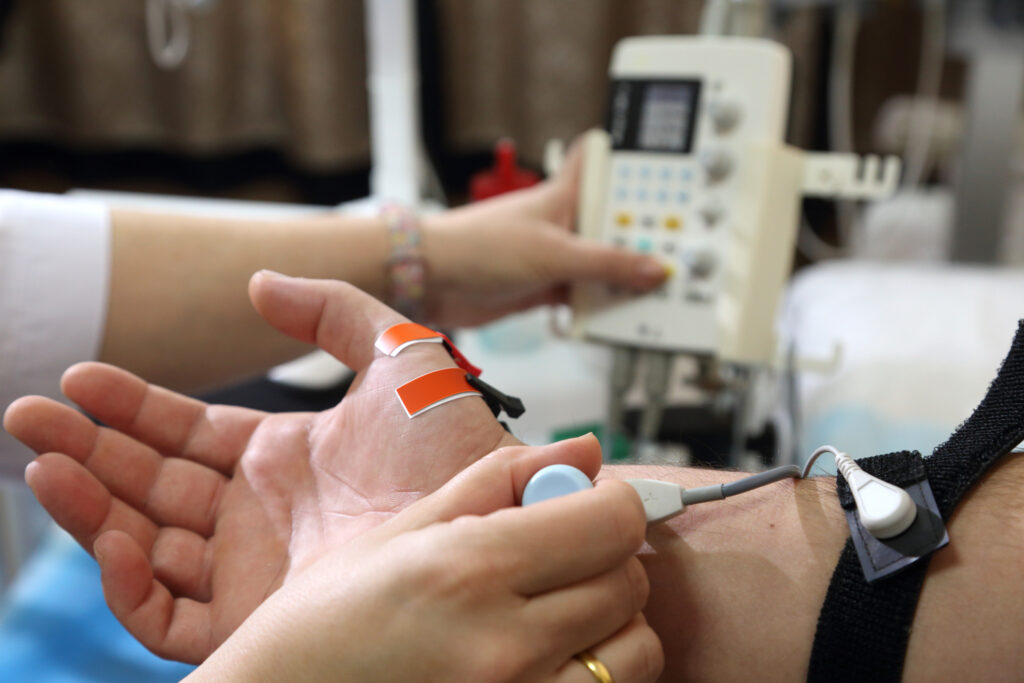
What Is an Electromyogram?
- Which nerves are affected
- Whether the problem is in the nerve itself or where it connects to the muscle
- Whether symptoms are consistent with a condition like carpal tunnel syndrome, radiculopathy, or peripheral neuropathy
What Is a Cervical Discogram?
A cervical discogram is a diagnostic procedure that determines whether a specific disc in the cervical spine (the seven vertebrae in your neck) is the source of your pain. It’s typically recommended when a patient has persistent neck pain, arm pain, or upper back pain that hasn’t been explained by magnetic resonance imaging (MRI) or other imaging.
During the procedure, a contrast dye is injected into one or more cervical discs under fluoroscopic guidance. Your doctor will ask you to tell them what you feel during each injection to see if they can reproduce your pain. This response helps determine which disc, if any, is symptomatic.
If a disc is identified as the source of your pain, that finding can support a targeted treatment recommendation, such as an injection, a surgical procedure, or continued conservative management.
Most doctors consider this test after other evaluations haven’t provided a clear enough answer to move forward with a plan.
What Is a Lumbar Discogram?
- Contrast dye is injected into one or more lumbar discs under fluoroscopic guidance
- You’re asked to describe your pain response during each injection
- A disc that reproduces your pain and is confirmed to be abnormal is considered a positive finding
How Do Diagnostic Results Fit into a Complete Spine and Orthopedic Evaluation?
- Symptom review and medical history: Your provider asks about the nature, duration, and location of your pain, as well as prior treatments, surgeries, and relevant medical conditions.
- Physical examination: Manual testing of strength, reflexes, range of motion, and nerve tension signs helps identify and support a diagnosis.
- Imaging review: X-rays, MRI, or computed tomography (CT) scans provide structural information about the spine, discs, and joints.
- Diagnostic testing results: EMG, discogram, or other findings are integrated with the above to narrow the diagnosis and guide care.
What Should I Expect Before Diagnostic Testing?
- A complete list of your current medications, including blood thinners and supplements
- Any known allergies, especially to contrast dye, latex, or anesthetics
- A history of prior spine or orthopedic procedures
- Any relevant medical conditions, such as diabetes, bleeding disorders, or active infections
Why Choose Interventional Spine & Surgery Group?
- Specialized expertise in spine, orthopedic, and nerve-related conditions
- Diagnostic testing integrated with clinical evaluation and individualized care plans
- Multiple locations across New Jersey for convenient access
- Comprehensive care for patients with complex or overlapping symptoms
- Same-week appointments are often available, so you’re not waiting for answers
